Reading on the Break
Hi, my name is Arya and I am going to be telling you guys about what book I have been reading during the coronavirus break. Being the careless person that I am, I didn't even think about what to read for the break so I didn't take any books from the library or from school. All I had were the books in my dad's personal library. Unfortunately, not many of those books were fiction and packed with action like most of the books I usually read. Instead, I chose an educational, eye-opening, and surprisingly fun to read book: The 7 Habits of Highly Effective People. It doesn't sound like a super fun book to read, which is what I thought when I picked up. Although it didn't sound like an interesting book to me, the deeper I got into it, the more I started to like it.
This book is a national bestseller and (as the title says) is about the habits of highly effective people. It's written by Stephen R. Covey, the chairman of the Covey Leadership Center and the Institute for Principle-Centered Leadership. He has a Harvard MBA and a doctorate from Brigham Young University. He is a famous international speaker and author on leadership, effectiveness, change, family, and interpersonal relationships.
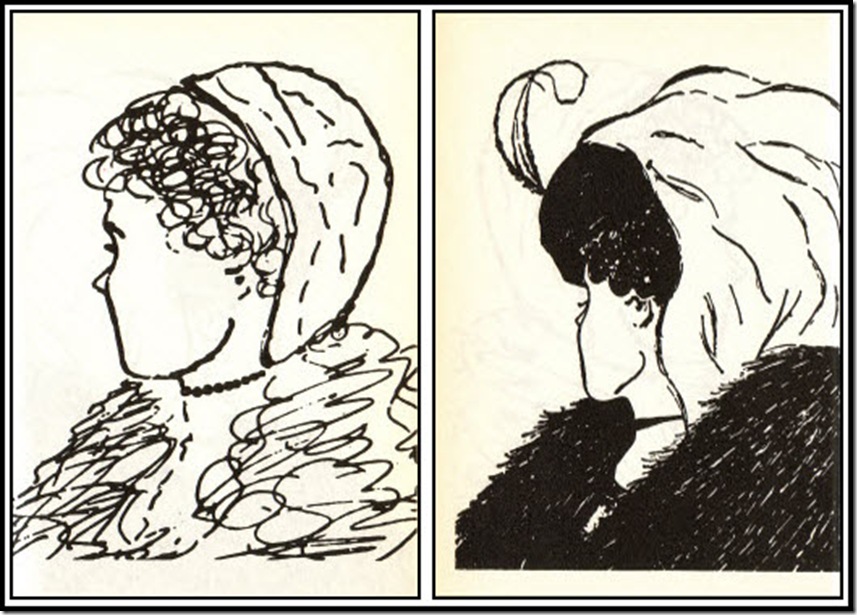
The book is divided into four parts: Paradigms and Principles, Private Victory, Public Victory, and Renewal. It follows the path that Covey and his family takes to attain personal change. Some of the book is comprised of half page anecdotes from Covey's own life that each represent a lesson regarding effectiveness. I can give you an example of one of these lessons if you look at the pictures below. I'm sure a lot of you have seen this images before. Think about what you see in each picture. Do you see a woman? How old is she? What is she wearing? Now look at the image on the left and then the one on the right. Some people would describe the image on the right as a young and fashionable woman, no more than 30 years old. I could argue that the image on the right is actually a picture of an old and frail woman with a huge nose. If you don't see the old lady, look at the picture at the very bottom of the page and then at the picture on the right. Do you see the old lady now? We could keep arguing back and forth on what the image represents until we clearly show each other what we each see. These images are examples of the power of paradigms. A paradigm, if you don't know, is the way we "see" the world. It's a theory or a model of how we perceive, understand, and interpret the things and people around us. The right paradigm has to be established before you start to change your behavior and create new habits. In this young and old lady example, the picture on the left and the picture at the bottom were the paradigms and the picture on the right is what we perceive in the real world. This experiment was described in the book and explains how different paradigms can lead to different perceptions of the same thing.

This book is a national bestseller and (as the title says) is about the habits of highly effective people. It's written by Stephen R. Covey, the chairman of the Covey Leadership Center and the Institute for Principle-Centered Leadership. He has a Harvard MBA and a doctorate from Brigham Young University. He is a famous international speaker and author on leadership, effectiveness, change, family, and interpersonal relationships.
The book is divided into four parts: Paradigms and Principles, Private Victory, Public Victory, and Renewal. It follows the path that Covey and his family takes to attain personal change. Some of the book is comprised of half page anecdotes from Covey's own life that each represent a lesson regarding effectiveness. I can give you an example of one of these lessons if you look at the pictures below. I'm sure a lot of you have seen this images before. Think about what you see in each picture. Do you see a woman? How old is she? What is she wearing? Now look at the image on the left and then the one on the right. Some people would describe the image on the right as a young and fashionable woman, no more than 30 years old. I could argue that the image on the right is actually a picture of an old and frail woman with a huge nose. If you don't see the old lady, look at the picture at the very bottom of the page and then at the picture on the right. Do you see the old lady now? We could keep arguing back and forth on what the image represents until we clearly show each other what we each see. These images are examples of the power of paradigms. A paradigm, if you don't know, is the way we "see" the world. It's a theory or a model of how we perceive, understand, and interpret the things and people around us. The right paradigm has to be established before you start to change your behavior and create new habits. In this young and old lady example, the picture on the left and the picture at the bottom were the paradigms and the picture on the right is what we perceive in the real world. This experiment was described in the book and explains how different paradigms can lead to different perceptions of the same thing.
Stephen Covey's book is filled with anecdotes, lessons, and stuff like this. He combines his personal life regarding his wife and his teenage boy with powerful lessons of personal change. Covey argues against what he calls "the personality ethic", which suggests that success is a function of personality, public image, behavior, and attitude. He promotes "the character ethic", a model which suggests that values and universal principles (integrity, humility, courage, etc.) lay the foundation for success. Covey sees principles as a set of natural laws while values are internal and subjective. Basically, our values decide our actions and the principles determine the consequences of those actions.
Overall, The 7 Habits of Highly Effective People doesn't really have the same feel as a math or science book. It also doesn't feel like a fiction or realistic fiction book. I can't quite describe the feel, but it's something in between. The book helps you to learn new things about yourself and the people around you, and it does it in a fun and interesting way. I would highly recommend this book to people with an interest in learning new things and improving themselves. If you have a problem in your life, this book will probably be able to help you fix it.
It was nice to read about how you got out of your comfort zone due to circumstance and actually discovered something you liked. I also liked how you actually engaged the reader with your activity and interpretation of the two pictures. Instead of a review, this felt more like a thought experiment, compared to the far numerous book reviews I have read. Overall, nice job.
ReplyDeleteI like how you took the time at the beginning of your review to explain to the readers of your review that although the book may seem boring it is worth reading in the end. I also like how explaining this didn't take up a huge portion of your review and how you were also able to talk a bit about the content of the book without making your review way too long. Good job.
ReplyDeleteThis book seems really cool, and your explanations were great. Your use of examples helps to get across what makes the book work, and you describe nicely why this book can be fun and engaging despite not being the most exciting. Also, it’s cool that you tried something new with an open mind and ended up enjoying it. Awesome review!
ReplyDeleteInteresting review. I like how you tried something out of your comfort zone that you didn't think you would like but ended up finding enjoyable and educational. I only had two library books with me before the library closed, so I may soon find myself in the same situation and start browsing our family library. Great job!
ReplyDelete